

Helping children in rural China feel heard: one day at a time
What happens when parents leave home for months, or even years, to work in distant cities?
In rural China, this is an everyday reality and parental migration profoundly impacts children's care and relationships. Children are often looked after by their grandparents and rarely have a say in the decisions that impact their lives, education and care. These skipped-generation households are now common, but what does life feel like for the children growing up in them? The collaborative engagement of an international research team including Rachel Murphy (University of Oxford), Li Mi (founder of Guiyu Academy - an open public welfare platform located in the countryside of Hunan which focuses on education, rural revitalization and sustainable development among Han and Yao communities in the Hunan countryside - and Central South University) and Xiaoyan Huang (CEO of Le Qun Social Work Service Centre, that trains social workers across China and Nankai University). They brought to light different elements of children's life where they would like to feel cared for, listened to and encouraged. Supported by the University of Oxford Impact Acceleration Account, this project sought to ask children about what they wanted their grandparent caregivers and other significant adults to know about them and their needs.
Why this matters
Listening to children is not just about hearing their words: it's about creating spaces where their voices can shape care and relationships. They need to know that they matter, Rachel Murphy explains. When parents migrate, children often bear the hidden costs of economic change. They miss out on daily contact, emotional support, and the chance to have a say in decisions that shape their lives.
This project connects directly to Sustainable Development Goal 10: Reduced Inequalities, especially Target 10.3 'Ensure equal opportunity and reduce inequalities of outcome, including by eliminating discriminatory laws, policies and practices and promoting appropriate legislation, policies and action in this regard'. Additionally, the project engages with Article 12 of the UN Convention on the Rights of the Child (UNCRC, 1989; UNCRC, General Comment 12, 2009), which says every child has the right to express their opinion and have their say.
Turning research into action leading to a change
The research team worked with local artists, Dali Tao and Xiao-Ou Zhou, to create something practical and beautiful: a calendar filled with ideas for grandparents and children to connect. Drawing on principles of Chinese medicine, the calendar suggests ways to notice feelings, ask questions, listen actively, and encourage without comparison. The artists also designed a board game to bring these ideas to life. It's a playful way for grandparents and grandchildren to spend time together, away from chores, homework, and screens, while learning to listen and interact in new ways.
Looking ahead
The in-depth interviews with children conducted so far by the research team have brought to light different elements of children's life where they would like to feel cared for, recognized, listened to and encouraged. By collaborating with these local artists the team has been able to turn some of these themes into detailed illustrations that capture different elements of the children's day to day lives and the hopes they have for how they can be looked after and supported.
This project shows that when we listen to children, we learn how to build stronger, more caring relationships. Children disproportionately bear the social costs the economic restructuring that has led to many parents living and working away from home for many months at a time (see Murphy, 2022, p.181). In this context, relationships matter, and that listening to children can help bridge the gap between generations.
The 2026 Calendar is open access as the team would love to engage with as many children and grandparents as possible. Download the calendar and, if you have used it, take part in our short survey to share your experience.
Excerpt from calendar
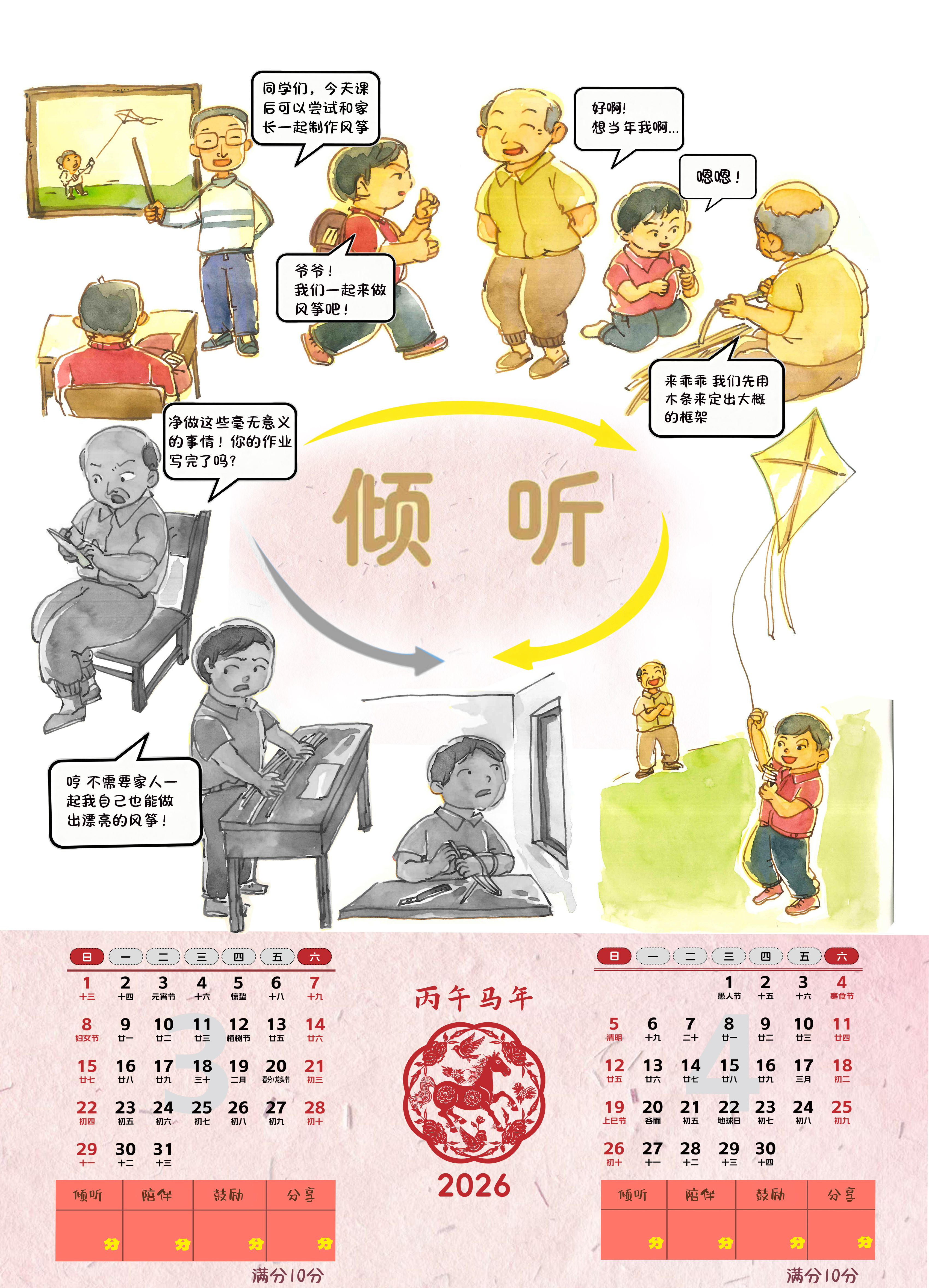
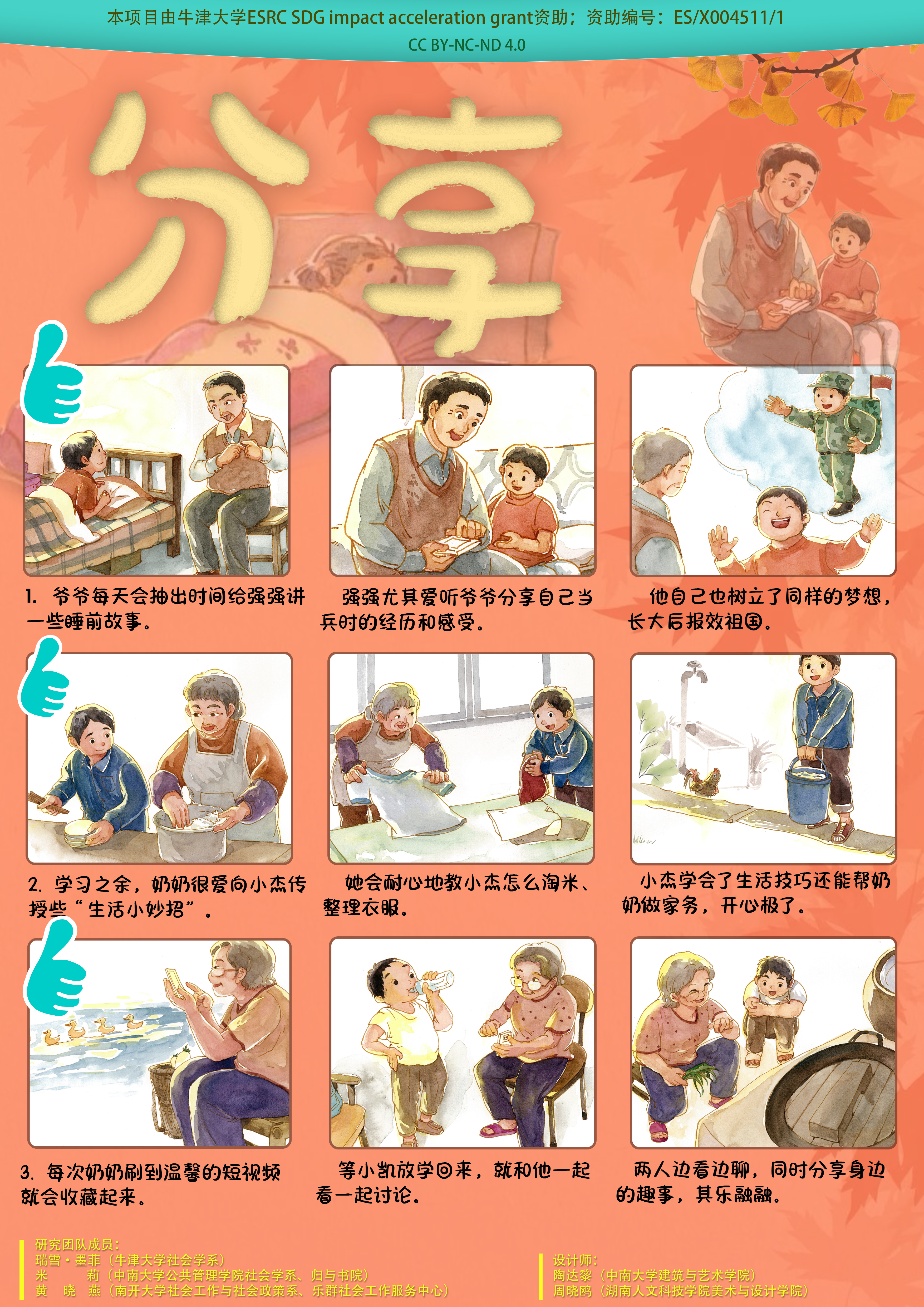
The project Empowering Social Workers and Caregivers in China's Small Cities, Towns and Villages to Support Children Who are Living Without Their Parents is supported by the University of Oxford Impact Acceleration Account. Grant reference ES/X004511/1.