



Akida Anwar recognised for academic and artistic achievements
Akida Anwar (Aikedan Ainiwaer) has received international recognition for her research on ageing and gender in urban China, alongside awards for her artistic practice.
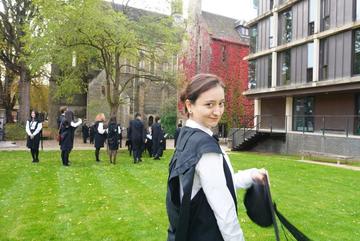
Credit: Akida Anwar
Akida has recently completed her DPhil in Area Studies (China) at the Oxford School of Global and Area Studies and has received a series of honours recognising both her academic research and artistic practice, highlighting her growing profile as an emerging scholar working across disciplines and cultures.
Most recently, Akida was named a recipient of the Emerging Scholar Award from the Aging & Social Change Research Network, an international recognition awarded to promising early-career researchers who demonstrate excellence in their fields and make significant contributions to understanding ageing and social transformation.
Her doctoral research examines ageing, gender and later-life relationships in urban China, focusing on romantic cohabitation as an emerging form of companionship and mutual support among older adults. As China experiences profound demographic change, her work explores how older people are creating new forms of care, intimacy and social connection beyond traditional family structures.
The significance of this research has been recognised through publication in the journal Population Ageing. In her article, Shared Roofs and Equal Roles? Navigating Gender in Later-life Intimacy through Cohabitation in Urban China, Akida draws on extensive fieldwork in Beijing, including semi-structured interviews and participant observation. The study examines how older cohabiting couples negotiate care, domestic responsibilities and financial arrangements during cohabitation. Its findings challenge conventional assumptions about ageing, relationships and family life, revealing how cohabitation reshapes gender roles and fosters a more egalitarian dynamic through shared domestic labour, negotiated financial practices, and redefined expectations of care. Crucially, however, this egalitarian dynamic does not arise from explicitly egalitarian gender ideologies. Rather, it emerges contingently through the temporal and biographical circumstances of later life, as partners negotiate changing needs, resources, and responsibilities.
Akida's research is also gaining international visibility through a series of conference presentations. In June, she presented her recently published paper at the British Society of Gerontology Annual Conference(BSG), one of the United Kingdom's leading interdisciplinary gatherings for ageing research. She also presented a poster based on her DPhil research, which was awarded the Journal of Global Ageing Poster Prize announced at the closing ceremony of BSG. In October, she will also present her research at the Sixteenth Interdisciplinary Conference on Aging & Social Change, hosted by Akdeniz University in Antalya, Türkiye. Bringing together scholars, practitioners and policymakers from around the world, the conference explores the social, cultural and political dimensions of ageing in a rapidly changing world.
These opportunities reflect the growing recognition of Akida's contribution to contemporary debates on ageing societies, changing family structures, gender relations and later-life wellbeing.
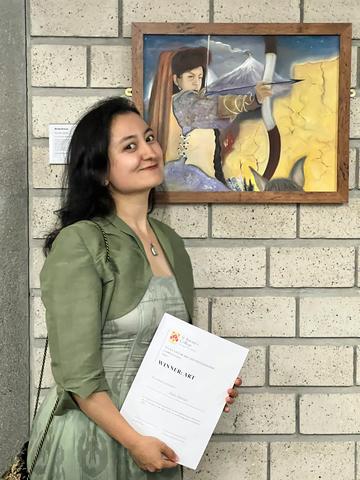
Akida Anwar and her award-winning painting 'The Will' (Credit: Akida Anwar)
Alongside her academic achievements, Akida has established herself as an accomplished artist. Her oil painting The Will has received wider recognition through its shortlisting for the Royal Academy of Arts Summer Exhibition 2026. This painting was also awarded the Allan Taylor Art and Photography Award at St Antony's College, Oxford. This artwork explores themes of nature, culture and tradition; it depicts the Dolan people's traditional art of horseback archery, celebrating the underrepresented cultural heritage. Following its selection as the winning artwork, the painting is now displayed in the Hilda Besse Building at St Antony's College until June 2027.
As an OSGA Research Associate in Chinese Studies, Akida's next step is to pursue postdoctoral research, building a long-term academic career centred on ageing from creative perspectives. She aims to explore how cultural and artistic engagement can enhance wellbeing, strengthen social connections, and provide meaningful avenues for self-expression in later life. Through this work, she hopes to develop interdisciplinary collaborations that bring together the social sciences, humanities, and the arts, advancing both scholarly understanding and innovative approaches to supporting ageing populations.
Together, these accomplishments reflect the range and impact of Akida's work both within and beyond academia. Whether through research exploring how older adults navigate social change or through artistic practice exploring questions of culture and nature, her work is united by a commitment to understanding the human experience in all its complexity. By integrating rigorous scholarship with a creative angle, method and expression, she seeks to generate knowledge that is both intellectually meaningful and socially engaging.
Commenting on the relationship between her research and artistic practice, Akida said:
Although my research and artistic practice take different forms, they are driven by the same curiosity about the human experience. My research is fundamentally concerned with how people exercise agency across the life course and how their lives are shaped by time, changing relationships, and social transformation. These questions of temporality, identity, and belonging also underpin my artistic practice. While my research examines them through both qualitative inquiry and quantitative sociological analysis, my art provides a different language for exploring the emotional and cultural dimensions of these experiences through visual storytelling.
I see art as a way of communicating ideas and emotions that are sometimes difficult to express through academic writing alone. It enables me to connect with wider audiences and invites reflection on culture, memory, and belonging in ways that complement my research. At the same time, my academic work encourages me to look beneath the surface of everyday experiences, and that perspective naturally informs my artistic practice.
Looking ahead, I hope to bring these two strands of my work into closer dialogue through research on creative ageing. I am particularly interested in exploring how artistic engagement can deepen our understanding of later-life experiences while fostering wellbeing, social connection, and meaningful participation. For me, research and art are not separate pursuits—they are complementary ways of asking questions, generating insight, and engaging with the complexities of human life.

