


When the Market Floods: Lagos's Informal Workers and the Resilience the City Cannot See
Gbenga Akinlolu Shadare
4 June 2026
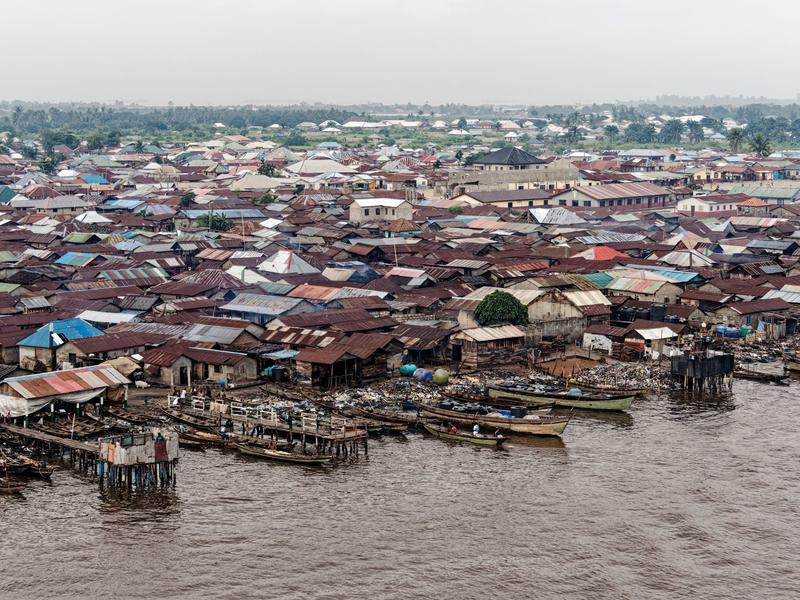
Credit: Adobe Stock/ manola72
Every year, when the rains arrive in Lagos, Amina moves faster than the water.
A market trader in Oshodi, she doesn't wait for government alerts or emergency services. She shifts her goods to higher ground, operates a shared grinding machine with her sister, and taps into a rotating savings group, locally known as ajo, to access emergency funds if flooding damages her stock. By the time the water recedes, she is already trading again. Amina is not exceptional. Across Lagos, Nigeria's commercial megacity of more than 20 million people, a version of her story plays out every rainy season in markets, waterfront settlements, and transport hubs. It is a story of improvisation, collective intelligence, and quiet organisational sophistication, and it has been almost entirely invisible to the urban planners and disaster managers who are supposed to keep the city running.
My recently published article seeks to change that. Drawing on interviews with 45 informal workers, six focus group discussions with worker associations, and 150 hours of participant observation across Makoko, Oshodi, and Lagos Island, the study examines how informal workers perceive, experience, and respond to climate-related disasters, and what their strategies reveal about the future of urban resilience in the Global South.
A City Built on Informal Labour
Lagos is one of Africa’s largest and fastest-growing megacities, with population estimates already exceeding 20 million in some accounts. Between 60 and 70 per cent of its workforce operates in the informal economy, including market traders, street vendors, artisans, waste recyclers, and transport operators who provide essential goods and services that the formal city cannot or does not deliver. These workers are not peripheral to Lagos's functioning. They are central to it. They keep food affordable, keep waste moving, keep people mobile. Yet they operate outside formal regulatory frameworks, without legal protections, secure land tenure, or meaningful access to disaster management systems. When flooding hits, and it hits repeatedly, with major flood events in 2011, 2012, 2019, 2022, and 2023, informal settlements and open-air markets absorb the worst of it.
The IPCC projects that sea-level rise and intensifying rainfall will worsen Lagos's flood exposure throughout the twenty-first century. Understanding how the city's most exposed workers adapt is not an academic footnote. It is a matter of urgent practical importance.
How Informal Workers Build Resilience
Informal workers build resilience through five overlapping adaptive strategies. These strategies do not remove the structural risks they face, but they show how workers mobilise income, relationships, space, collective organisation, and selective engagement with formal systems to survive and recover after flooding.
The first is livelihood diversification. Workers and traders like Amina maintain multiple income streams that can be activated, scaled up, or down depending on conditions. Female traders and informal workers combine market activities with home-based food processing or tailoring; male artisans diversify across carpentry, roofing, and plumbing. Diversification is both a deliberate strategy and a survival necessity, though it yields narrow margins and can be exhausting to sustain.
The second is the activation of social networks. Rotating savings groups, kinship ties, trade associations, and religious communities function as informal insurance. When flooding damaged Bisi's fabric stock, she drew on her ajo group to raise funds early and replace her inventory within days, with no collateral required and no bureaucratic delays. When the government did not arrive for three days after the 2023 flooding, market association chairman Alhaji Musa organised his members to pump out water and sandbag vulnerable stalls themselves.
The third is spatial intelligence. Informal workers carry detailed mental maps of which streets flood first, which routes remain passable, and where materials accumulate after the water recedes. Waste recycler Emeka described modifying his collection routes hour by hour in response to rising water, and knowing precisely where to find post-flood materials before formal waste systems could mobilise. Market stalls across all three research sites feature elevated floors, mobile carts, and waterproof containers: modest but effective adaptations built from hard experience.
The fourth is collective organisation and advocacy. Trade associations petition local governments, coordinate infrastructure improvements, and occasionally organise protests when authorities fail to act. In Oshodi, one association successfully pressured local government authorities to clear drainage channels before the 2023 rainy season. These are acts of political agency, not passive endurance.
The fifth is hybrid engagement with formal systems, including selectively accessing government relief programmes, negotiating with market authorities, and partnering with NGOs on flood preparedness. The relationships are complex and often contradictory, shaped by patronage, corruption, and uneven state responsiveness. But informal workers navigate them strategically, maintaining autonomous systems while drawing on external resources where they can.
The Limits of Resilience from Below
None of this is cause for uncomplicated celebration. The resourcefulness documented in this research is real, but it emerges from conditions of marginalisation rather than choice. These workers and traders are building resilience in the absence of the infrastructure, legal protections, and services that should exist but do not. The “spatial trap” is a case in point. When food vendor Grace relocated to higher ground after flooding destroyed her home, she spent three hours a day travelling back to her customers. She returned to the flood zone, knowing the risks, because the economic geography of Lagos's informal markets left her no viable alternative.
Social networks, too, have their limits. In the most severe flood events, when entire neighbourhoods go under simultaneously, mutual support systems become overwhelmed. The most marginalised workers, those without ethnic affiliations, trade association membership, or stable locations, fall entirely outside these networks. Women, despite constituting the majority of members in most markets, are frequently marginalised in association decision-making.
Celebrating informal resilience without acknowledging what it compensates for risks normalising precarity and absolving states of their responsibilities.
What Urban Governance Needs to Learn
The implications of this research extend well beyond Lagos. Cities across the Global South face intensifying climate risks alongside large and growing informal economies. The question is not whether informal workers contribute to urban resilience; the evidence is clear that they do. The question is whether urban governance systems will recognise, support, and learn from these contributions.
That means institutional mechanisms for informal worker participation in urban planning and disaster risk reduction, not token consultation but a genuine voice. It means extending drainage infrastructure, waste collection, and flood protection to informal settlements rather than treating them as temporary anomalies awaiting demolition. It means designing social protection systems that work for workers without documentation or formal employment contracts, and it means securing land tenure so that workers can invest in flood-proofing without the constant threat of eviction.
Above all, it requires a shift in how we think about urban knowledge. The informal workers in this study know their city's flood patterns, its drainage failures, its rhythms of risk, in ways that no engineering survey has captured. That knowledge is a resource. Ignoring it is not just analytically impoverished; in a climate crisis, it is a governance failure.
This article is based on 'Reimagining resilience: informal workers and adaptive strategies for post-disaster urban futures in Lagos, Nigeria', published in the International Journal of Sociology and Social Policy (2026). DOI: 10.1108/IJSSP-01-2026-0051
Author bio
Gbenga Akinlolu Shadare is a researcher and scholar affiliated with the School of Business, Law and Policing at Canterbury Christ Church University; the School of Sociological Studies, Politics and International Relations at the University of Sheffield; Arden University; and the Global Banking School, Birmingham. His research spans urban governance, informality, social protection, the gig and sharing economies, algorithmic management, platformisation, and climate resilience in African and Global South cities. He can be contacted at gbenga.shadare@canterbury.ac.uk.
NB: Names of informal workers and traders have been changed to protect participants’ identities.