

Rethinking Digital Sovereignty: Dependency, Power, and Africa's Tech Future
Bulelani Jili
17 April 2026

stock.adobe.com / poco_bw
In recent years, "digital sovereignty" has become one of the most influential concepts in debates about Africa's technological future. Across policy circles, development institutions, and corporate strategy documents, it promises something powerful: that African states can finally take control of their digital infrastructures, data, and technological trajectories.
But what if this promise rests on a misunderstanding?
My research in Kenya suggests that digital sovereignty is not always a path to greater autonomy. In some cases, it can deepen the very dependencies it is meant to overcome. Projects designed to strengthen national control still rely on foreign infrastructure, foreign capital, and foreign expertise. Rather than breaking from existing power structures, they can reproduce them in new ways.
This matters because digital sovereignty is increasingly treated as the obvious solution to Africa's place in the global tech economy. The assumption is that countries can build sovereignty step by step-through skills, infrastructure, and regulation. These efforts matter. But they do not, on their own, change the deeper structures of power within which digital development takes place.
Beyond the Illusion of Technological Escape
Much of the current enthusiasm around digital sovereignty rests on a familiar developmental logic: that technological capacity-particularly in artificial intelligence, data governance, and digital infrastructure-can enable African countries to "leapfrog" historical constraints.
This belief is not new. It echoes earlier moments in development thinking where technology was positioned as a solution to structural inequality. What is distinctive today, however, is how deeply this logic is embedded in policy frameworks.
Across Africa, governments are investing in digital skills training, data localization policies, AI strategies, and public-private partnerships with global tech firms. These initiatives are framed as steps toward autonomy. Yet, as the article shows, they often operate within-and depend upon-global systems of capital, expertise, and infrastructure that remain externally controlled.
The result is a paradox: the pursuit of sovereignty is enacted through dependency.
From Capacity Building to Performativity
To understand this paradox, we need to shift the question. Instead of asking whether digital sovereignty is being achieved, we should ask how it is being enacted.
In Kenya, one of the clearest examples is the focus on skills development. Programs that train workers in AI, cybersecurity, and data science are framed as essential to national independence.
But these programs also do something else. They embed global tech firms within public institutions, align education with external market demand, and prepare workers for roles in the lower-value segments of the digital economy. In this context, development becomes equated with training. Skills acquisition stands in for structural transformation.
What emerges is not a break from dependency, but its reconfiguration.
The Architecture of Digital Dependency
This dynamic becomes clearer when we look at how Africa's digital economy is structured. Rather than being dominated by a single country or company, it is organized across layers. Infrastructure is often built by Chinese firms. Platforms and software are largely controlled by U.S. companies. Labor is concentrated in lower-value roles such as content moderation and data labeling.
Each layer is governed elsewhere. Together, they create a system in which African economies are deeply integrated-but rarely in positions of control.
One of the most powerful ideas shaping policy today is what we might call the skills fix. Across governments and development institutions, digital skills are treated as the solution to everything-from unemployment to technological dependence. The logic is simple: train people, and the rest will follow.
But this framing misses a deeper issue.
Skills alone do not change a country's position in the global economy. Without ownership of platforms, control over data, and strategies for moving into higher-value sectors, training programs risk reinforcing existing hierarchies.
In this sense, the focus on skills does more than offer a solution-it shifts responsibility. Structural problems become individual ones. Development becomes a matter of self-improvement rather than systemic change.
| Layer | Description | Dominant Actors | Primary Geography of Control | Implications for Africa |
|---|---|---|---|---|
| Applications | User-facing platforms enabling communication, finance, commerce, and social interaction (e.g., social media, fintech, e-commerce). | Meta (Facebook, WhatsApp), Google, Microsoft, Amazon; Spotify; Alibaba; Orange Digital Ventures | U.S. (dominant); China & EU (secondary) | U.S. firms dominate application ecosystems, capturing user data, advertising revenue, and digital market share. African digital publics are deeply embedded in externally governed data and monetization architectures. |
| Operating Systems | Software environments managing device functionality and application ecosystems (e.g., Android, iOS, HarmonyOS). | Google (Android), Apple (iOS); Huawei (HarmonyOS); Linux Foundation | U.S. (dominant); China (emerging); EU (open-source influence) | Dependence on U.S. operating systems-especially Android-limits domestic control over software environments, data governance, and interoperability standards. Alternative ecosystems remain nascent or fragmented. |
| Consumer Devices | Hardware enabling digital access (smartphones, tablets, laptops). | Transsion (Tecno, Infinix), Huawei, Xiaomi; Apple; Nokia (legacy) | China (dominant); U.S. (premium segment); EU (residual) | Chinese firms dominate mass-market access through affordability and localization, expanding connectivity while reinforcing external control over upstream ecosystems and supply chains. |
| Infrastructure | Physical backbone of the digital economy (fiber-optic networks, data centers, submarine cables, cloud infrastructure). | Huawei, ZTE, China Telecom; Google (Equiano), Meta (2Africa); Vodafone; Orange | China (dominant in build); U.S. (growing in cloud/cables); EU (regional presence) | Chinese firms lead in construction and financing of infrastructure, while U.S. firms expand cloud and cable capacity. Infrastructure expansion increases connectivity but embeds systems within external technical and financial architectures. |
| Service Provision | Delivery of telecom and internet services to end users. | Safaricom, MTN, Airtel; Orange, Vodafone; Huawei & ZTE (equipment suppliers) | African firms (operations) with external technical dependency | African operators provide services but rely on foreign equipment, financing, and technical expertise-embedding service delivery within transnational ecosystems of dependency. |
| Regulation & Governance (Emerging Layer) | Legal and normative frameworks governing data, privacy, cybersecurity, and digital markets. | European Commission (GDPR); AU; USAID; FTC; Cyberspace Administration of China (CAC) | EU (normative leadership); U.S. & China (technical leverage); AU (partial coordination) | Regulatory regimes are hybrid: EU shapes formal legal standards ("Brussels Effect"), while U.S. and Chinese firms exert de facto governance through platforms and infrastructure. African sovereignty is enacted within externally shaped regulatory environments. |
Source: Author's compilation
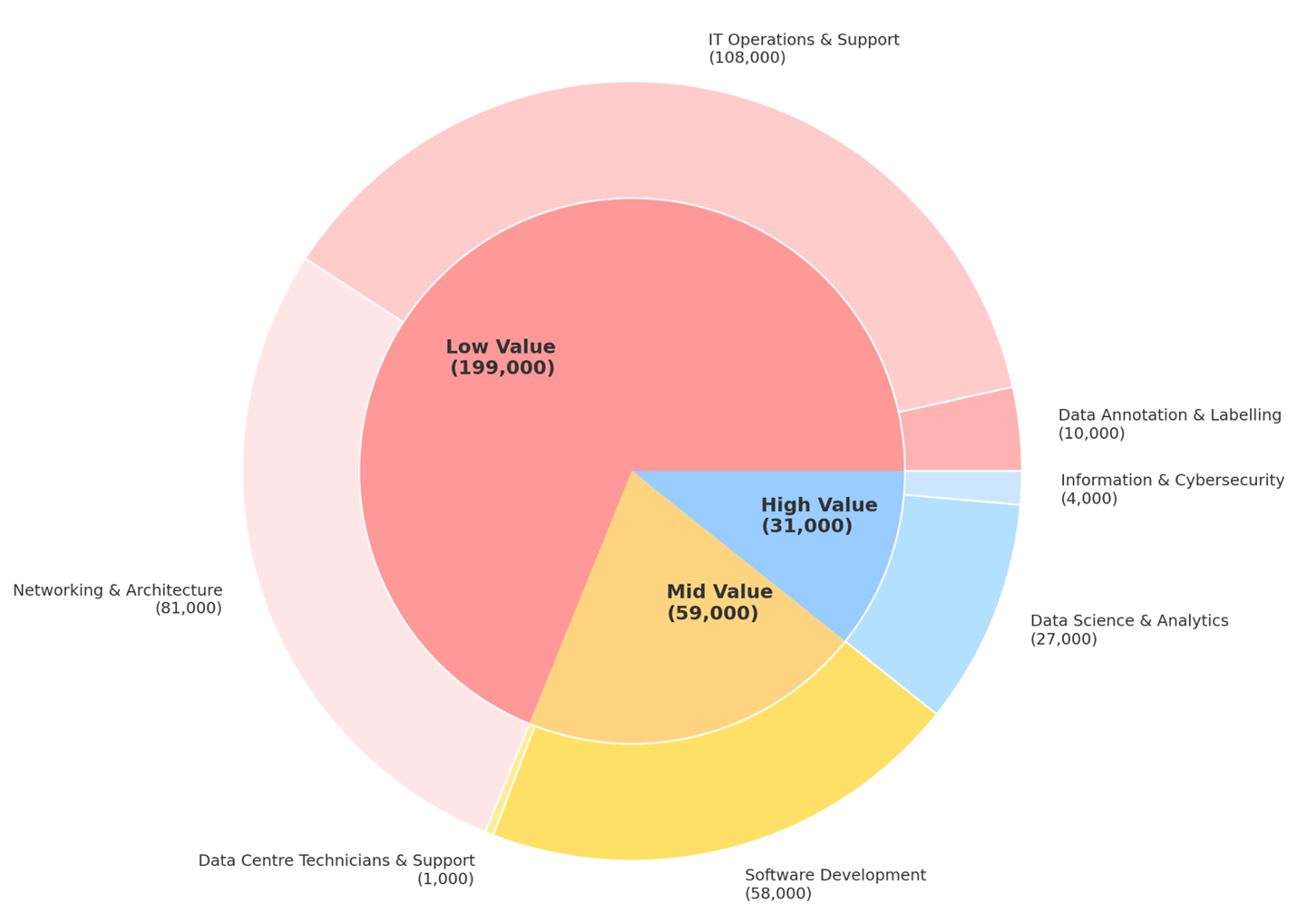
Figure 2: ICT Skill Stratification in Kenya, 2023Source: Author-compiled data from the Ministry of ICT
Dependency, Reimagined
This does not mean that African countries are passive or powerless. Dependency today is not simply imposed from outside. It is produced through relationships-between governments, firms, and global markets. African states actively negotiate, adopt, and shape technological systems.
But they do so within structural constraints that limit what is possible.
The key question, then, is not whether Africa is dependent or autonomous, but how agency and constraint are produced together-and how infrastructure, contracts, and institutions shape those relationships and outcomes.
Why This Matters
This argument has significant implications for both scholarship and policy. For scholars, it challenges dominant approaches to digital sovereignty that treat it as a measurable outcome, focus narrowly on data or infrastructure, and overlook the political economy of global tech systems. Instead, it calls for ethnographic attention to how sovereignty is enacted, analysis of infrastructure as a site of power, and a renewed engagement with dependency theory in the digital age.
For policymakers, it raises uncomfortable but necessary questions: Can sovereignty be achieved through partnerships that reproduce dependency? What would structural transformation actually require? Who benefits from the current configuration of digital development?
Toward a New Research Agenda
This reframing matters for both policy and scholarship. For policymakers, it raises difficult questions. Can sovereignty be achieved through partnerships that reproduce dependency? What would real structural transformation require? And who benefits from the current model of digital development?
For scholars, it suggests a shift in focus-from measuring outcomes to examining how power operates through infrastructure, education, and governance.
More fundamentally, it forces a harder question: What if the problem is not that Africa lacks technological capacity-but that the global system is structured in ways that limit what that capacity can achieve?
Until that question is taken seriously, digital sovereignty will remain less a destination than a performance-one that unfolds within, rather than beyond, the structures of global inequality.
Author bio
Bulelani Jili is an Assistant Professor at Georgetown University's School of Foreign Service, where he is affiliated with the African Studies Program and the Science, Technology, and International Affairs (STIA) Program. He is a Faculty Associate at the Berkman Klein Center for Internet & Society at Harvard Law School, a Fellow at New America, and an Advisory Board Member of the International Panel on Social Progress.